

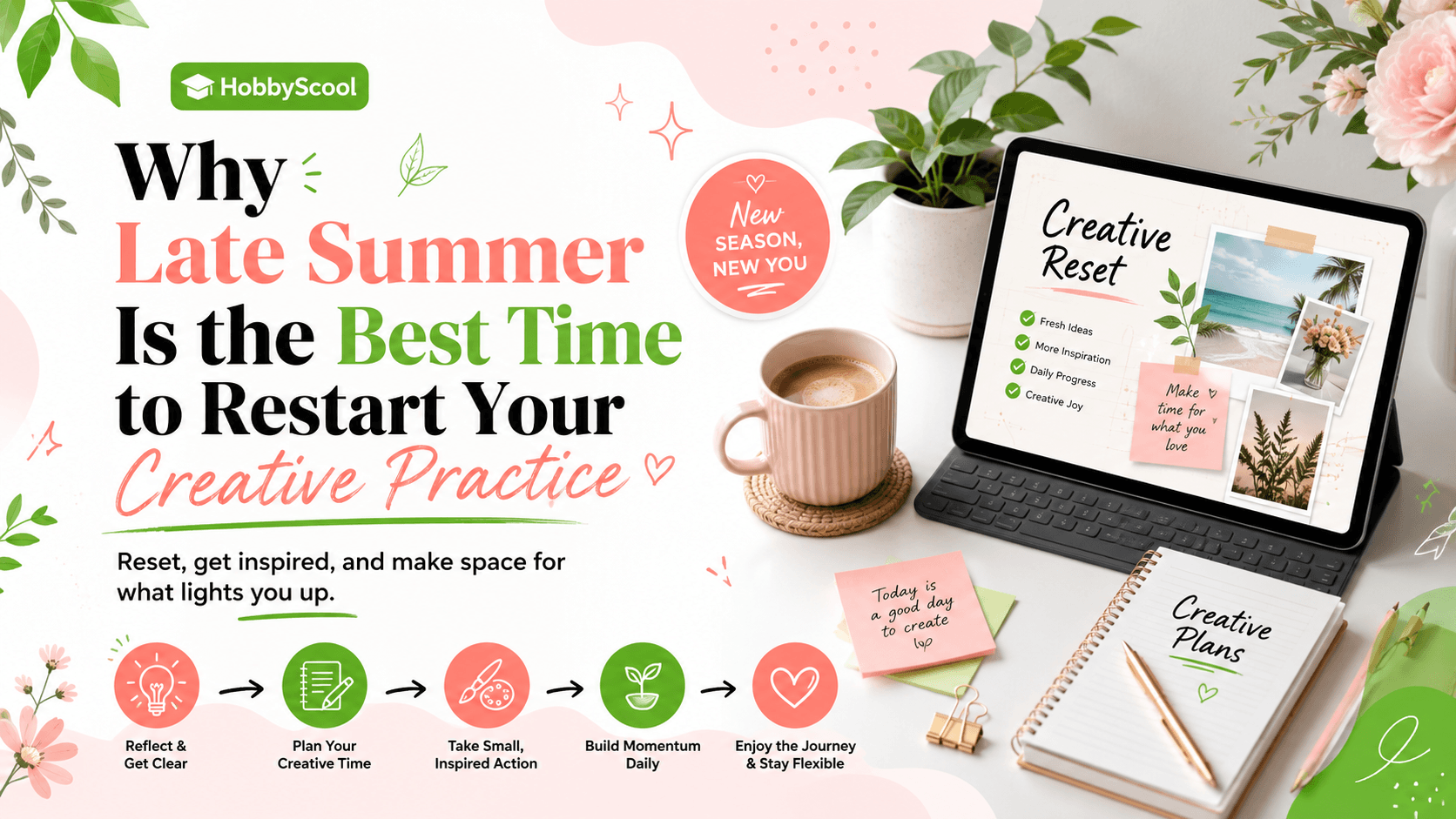
Why Late Summer Is the Best Time to Restart Your Creative Practice
If your sewing machine has been sitting under a pile of beach towels since June, you're not alone. Somewhere between the family trips, the kids' summer schedules, and the general chaos of the season, most makers lose their creative rhythm entirely. The needle felting kit gets pushed to the back of the closet. The half-finished quilt block sits in a basket, waiting. And by the time August rolls around, it can feel less like "I took a break" and more like "I forgot how to do this."
Here's the good news: that feeling is completely normal, and late summer is actually one of the best possible moments to pick your practice back up.
Why Your Creative Routine Falls Apart in Summer
Creative hobbies thrive on small, repeatable pockets of time — the twenty minutes before bed, the quiet hour on a Sunday morning, the stretch of afternoon while dinner simmers. Summer takes a wrecking ball to exactly those pockets. Kids are home. Schedules shift daily. Trips interrupt any sense of routine. None of that means you've lost your skill or your love of the craft — it just means the scaffolding that used to hold your practice in place is temporarily gone.
At HobbyScool, we've been tracking this pattern across our community for years, and August is consistently the month when makers tell us they're ready to "get back into it" but aren't sure where to start. That hesitation is the real obstacle — not a lack of skill, but a lack of an easy on-ramp.
"The hardest part of returning to a creative hobby isn't relearning the skill. It's just starting the first project again."
— HobbyScool Creative CommunityLate August Is a Natural Reset Point
There's a reason "back to school" energy hits adults too, even if there's no school involved. The change of season signals a fresh start. Routines reset. Evenings get a little cooler and a little quieter. It's the same psychological trigger that makes January 1st feel like a clean slate — except this one doesn't come loaded with resolutions and pressure. It's simply a natural window to pick something back up.
Rather than trying to white-knuckle your way back into a full creative routine on your own, the easiest path back in is often a guided one: a class, a project, a community of people doing the same thing at the same time.
A Free Way Back In: The Back-to-Creativity Summit
That's exactly what we built the Back-to-Creativity Summit for. It's a free, three-day virtual event running August 18–20, 2026, and it's designed specifically for this moment — the moment when you're ready to reconnect with your creative side but don't want to figure out where to begin on your own.
Thirty-one instructors are teaching hands-on workshops across three themed days:
Aug 18
Quilt & Fiber Foundations
Perfect for anyone wanting to build (or rebuild) core quilting skills, from beginner-friendly quilt blocks to appliqué and free-motion techniques.
Aug 19
Sew, Stitch & Textile Play
Weekend-friendly sewing projects, embroidery, and creative ways to use fabric scraps you already have on hand.
Aug 20
Paint, Clay & Make Anything
A day for makers who want to branch out — polymer clay earrings, painted totes, color theory, and more.
You don't need any experience to attend, and you don't need to commit to all three days. Pick the theme that matches whatever craft you're most itching to return to, and start there.
What Makes This Different From "Just Watching a Tutorial"
The reason so many people fall off after watching a single YouTube tutorial is that there's no momentum, no community, and no next step. A summit format fixes all three at once — live energy, a group of people learning alongside you, and a clear schedule that carries you from one project to the next.
Every workshop is taught by a real instructor with real experience in their craft — not a generic how-to, but a genuine skill-share from someone who teaches this for a living. And because sessions are organized by theme and skill level, you're not stuck guessing whether a workshop is right for you.
For makers who want to go deeper, a VIP pass is available with extended access and bonus resources contributed directly by the instructors — think patterns, mini-courses, and templates you can keep using long after the summit ends.
How to Actually Make This Reset Stick
A summit is a great spark, but a few small habits will help the momentum last past the closing session:
- Pick one project, not five. Finishing one small thing beats starting a dozen big things.
- Block the time on your calendar now. Treat the summit sessions like an appointment, not a "maybe."
- Set up your space before Day 1. Half the battle of restarting a hobby is just having your supplies within reach.
- Join the community piece, not just the content. Learning alongside other makers is what makes the habit stick after the event ends.
You don't have to have your entire creative practice figured out by August 18th. You just have to show up for one workshop, on one day, and let that be the thing that gets you moving again.
Register for the Back-to-Creativity Summit
August 18–20, 2026 · 31 instructors · Quilting, sewing, painting, clay, and more. It's free to join — save your seat today.
Frequently Asked Questions
Summer brings travel, kids being home from school, and packed social calendars, which crowd out the quiet, repeatable time creative hobbies need. Once the routine breaks, it's easy to feel like you've lost your rhythm entirely, even though the skill and the desire are still there.
The Back-to-Creativity Summit is a free three-day virtual event from HobbyScool running August 18–20, 2026, featuring 31 expert instructors teaching workshops across quilting, sewing, textile art, painting, polymer clay, and more.
No. The summit is built for makers at every level, from people picking up a needle or paintbrush for the first time to experienced crafters looking to learn a new technique or medium.
General registration for the live summit sessions is free. An optional VIP pass is available for anyone who wants extended access and bonus resources from the instructors.
The summit is organized into three daily themes: quilting and fiber foundations, sewing and textile play, and painting, clay, and mixed media. Pick the day that matches the craft you most want to return to, and start there.
