

The Case for a Handmade Hobby: A Mindful Way to Slow Down
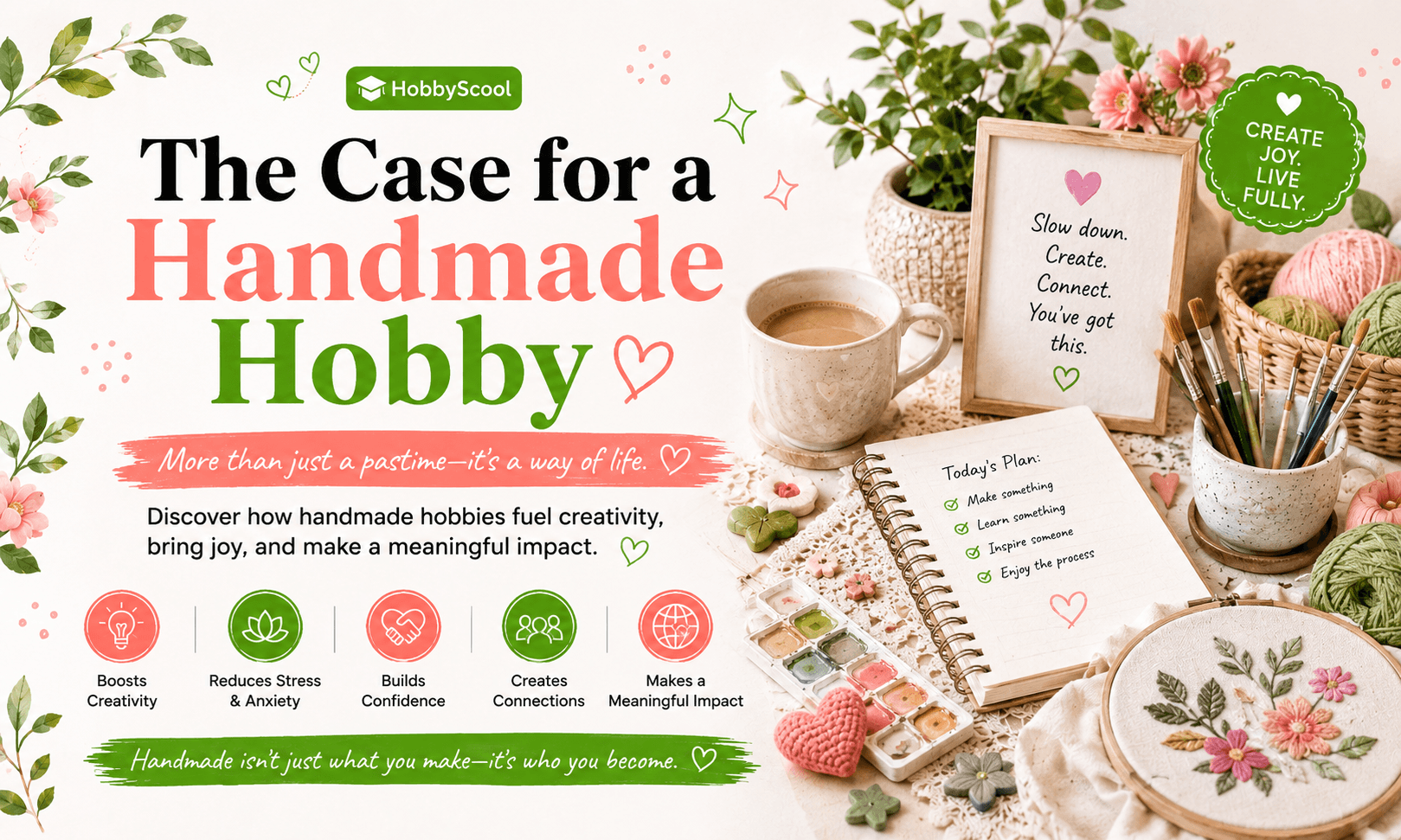
There's a particular kind of tired that comes from a day spent almost entirely on screens. You haven't lifted anything heavy. You haven't run anywhere. But by evening your eyes ache, your thoughts feel scattered, and scrolling one more app somehow feels both exhausting and impossible to stop. If that sounds familiar, this post isn't going to tell you to meditate for an hour or delete your apps. It's going to make the case for something smaller and much more doable: picking up a handmade hobby.
Not because it's trendy. Not because you need one more thing to be good at. But because there's real, well-documented psychology behind why working with your hands — slowly, imperfectly, without a deadline — is one of the most accessible tools we have for feeling calmer.
The Cost of a Passive-Scroll Life
Passive consumption — scrolling, autoplay, refresh-and-repeat — asks almost nothing of your attention and gives almost nothing back. It's not that rest is bad; it's that a lot of what we call "downtime" isn't actually restful. It's stimulating in a shallow way: quick hits of novelty that keep your brain lightly activated without ever letting it settle into anything.
Creative, hands-on work asks for something different. It asks you to slow down enough to notice what your hands are doing, which means it can't run in the background while your mind is somewhere else. That single shift — from passive intake to active, tactile attention — is a lot of where the wellness benefit comes from.
What "Flow State" Actually Feels Like
Psychologist Mihaly Csikszentmihalyi spent decades studying what he called "flow" — the mental state you enter when you're fully absorbed in an activity that's challenging enough to hold your focus, but not so hard that it triggers anxiety. Time distorts. Self-consciousness fades. You're not thinking about your to-do list or the email you haven't answered; you're just doing the thing in front of you. Psychology Today's overview of the concept describes it as one of the most reliable paths to a sense of well-being that we know of (Psychology Today, "Flow").
Handmade crafts are almost custom-built for flow. Think about the rhythm of a knit stitch, the repetitive motion of hand-stitching a seam, the slow build of layering paint or paper. Each of these has a natural learning curve — enough challenge to keep you engaged, enough repetition to let your mind settle into the motion instead of racing ahead of it. That's the flow sweet spot, and it's a big part of why people describe craft time as "meditative" even when they've never formally meditated a day in their life.
Process Over Product
One of the most freeing ideas in creativity and mindfulness research is "process over product" — the notion that the psychological benefit lives in the doing, not in what gets made. This matters enormously for anyone who has ever avoided a craft because they were sure they'd be bad at it.
You don't need your embroidery to be gallery-worthy for the twenty minutes you spent stitching to have done something for your nervous system. A lopsided first attempt at a felted mushroom or a wobbly hand-sewn pocket square still gave your hands something specific and rhythmic to do, and gave your mind a break from everywhere else it usually goes. The finished object is a nice bonus. It was never the point.
At HobbyScool, we've been tracking this shift for a while now: more and more of our community is showing up not to build a side hustle, but simply to have one hour a week where their hands are busy and their phone is face-down. That's a completely valid reason to pick up a craft — maybe the best one.
Why Your Hands, Specifically
There's something about tactile, physical work that screens can't replicate. Feeling yarn move through your fingers, watching clay change shape under gentle pressure, hearing the specific sound of a good pair of scissors through paper — these are sensory experiences your body can track in real time, which tends to pull attention out of your head and into the present moment. That's a plain-language description of mindfulness: paying attention, on purpose, to what's happening right now, instead of replaying the past or rehearsing the future.
This is also why so many people say a hobby helps them "turn their brain off" even though, technically, their brain is quite active while they're doing it. It's not off — it's just occupied with something immediate and manageable instead of something abstract and looping.
A Few Reasons Handwork Tends to Feel Calming
- It's rhythmic. Repetitive motions — a knit stitch, a running stitch, smoothing clay — have a soothing, almost metronomic quality.
- It's single-tasking. Most crafts genuinely can't be multitasked, which forces a kind of attention we rarely give ourselves permission to have anymore.
- It's low-stakes. Nobody is grading your art journal page. There's no performance review for a macrame keychain.
- It's tangible. You can see and hold progress, which is a very different feeling from an inbox that refills the moment you empty it.
- It's screen-free. Your eyes, hands, and attention all point in the same direction for once.
You Don't Need to Be "Creative" to Start
If the word "hobby" makes you think of a skill you don't have, it might help to reframe it: this isn't about becoming a maker with a following or a shop. It's closer to a stress-relief practice that happens to leave you with a tote bag, a card, or a little clay dish at the end. If you've ever wanted permission to try something with your hands purely because it feels good, not because you need to be good at it — this is your sign.
You also don't need a studio, a stack of expensive supplies, or hours of free time. Ten or twenty focused minutes with a needle and thread, a sketchbook, or a lump of polymer clay is enough to feel the shift. The goal isn't to add another obligation to your week. It's to trade a little bit of scrolling for a little bit of making, and see how it feels.
One Low-Pressure Way to Start
If you're curious but don't know where to begin, HobbyScool's creative community has an easy, no-cost on-ramp coming up: The Art of Handmade Summit 2026, running September 15–17. It's a free, three-day online event where 33 expert makers each teach a workshop — 11 new sessions released every morning, free to watch for 24 hours. There's no app to download, no special equipment required to join, and no credit card at any point. You register once, and each day's workshops simply arrive as links in your email.
The theme running through all three days is exactly the idea at the center of this post: slow down, work with your hands, and remember how good it feels to make something that's truly, unmistakably yours. You can drop in for a single session that catches your eye or spend all three days sampling paper crafts, fiber arts, and clay. There's no "right" way to attend — that's kind of the point.
The Three Days at a Glance
Botanical printing, mini albums, art journaling, interactive cards, and hand-drawn florals. 11 free workshops, live for 24 hours.
Sewing, embroidery, knitting, crochet, and macrame. 11 free workshops, live for 24 hours.
Polymer clay, mixed media, quilting, fabric painting, and home decor. 11 free workshops, live for 24 hours.
Day 3 is especially worth flagging for anyone reading this because the wellness angle spoke to them. That's the day maker Sam Hill teaches a session built entirely around this idea:
Knit Your Way to Calm — Sam Hill
On Day 3, Sam Hill's session, "Knit Your Way to Calm: How to Slow Down, Stress Less & Recharge Through Creativity," is one of 11 workshops released that morning and free to watch for 24 hours — a direct, hands-on companion to everything in this post.
You don't have to already know how to knit, sew, or sculpt to get something out of the summit. Most sessions are built for makers starting from zero, and the whole format is designed so you can watch, pause, and try things at your own pace — no pressure to keep up, no audience watching you learn.
Making It a Habit, Not Just an Event
A three-day summit is a great low-pressure entry point, but the real benefit of a handmade hobby comes from returning to it. You don't need a rigid schedule — even a loose habit of "hands busy, phone away" a couple of times a week can be enough to notice a difference in how your evenings feel. Keep a small project within reach: a bag of embroidery floss by the couch, a sketchbook on the nightstand, a lump of clay in a drawer. The lower the barrier to starting, the more likely you are to actually sit down and do it.
It's also worth noticing what you feel afterward, not just during. Many people report that the calm from a session of handwork lingers — a kind of settled, accomplished feeling that a similar amount of scrolling rarely leaves behind. That's not a scientific claim so much as a pattern worth testing for yourself. The Art of Handmade Summit is a low-cost way to run that experiment across a dozen different crafts in a single week and see which one sticks.
Save Your Free Seat
The Art of Handmade Summit runs September 15–17, 2026 — 33 free workshops, no credit card required.
Frequently Asked Questions
Flow is the term psychologist Mihaly Csikszentmihalyi used to describe the feeling of being fully absorbed in an activity that's challenging enough to hold your attention but doable enough that you're not anxious about it. Handmade crafts are a classic way into flow: a repetitive stitch, a shaping motion, a next-step-at-a-time project. Because flow crowds out the mental chatter and rumination that fuel stress, many people find that time spent knitting, sketching, or working with clay leaves them calmer than time spent scrolling, even though both can fill an hour.
No. The wellness benefit comes from the process, not the finished piece — this is the "process over product" idea that shows up throughout mindfulness and creativity research. A wobbly first pocket square or a lopsided first mug still gives your hands and mind the same slow, focused engagement as a polished one. At HobbyScool, we tell beginners the same thing every time: the goal isn't a perfect object, it's twenty screen-free minutes where your hands were busy and your mind got quiet.
The Art of Handmade Summit 2026 is a free, three-day online event from HobbyScool running September 15–17, 2026. There's no cost, no credit card required, and no app or special software — you just click the link in your daily email. Each morning, 11 new workshops from expert makers go live and stay free to watch for 24 hours, covering everything from paper crafts to fiber arts to polymer clay.
On Day 3 (Thursday, September 17), Sam Hill leads a session called "Knit Your Way to Calm: How to Slow Down, Stress Less & Recharge Through Creativity," which speaks directly to the mindfulness angle in this post. It's one of 11 workshops released that day alongside sessions on polymer clay, upcycled decor, quilting, and more.
No special equipment or app is required to attend. The Art of Handmade Summit is 100% online — you register once, and each day's workshops arrive as links in your email that you can click and watch. Some individual workshops may call for basic craft supplies depending on the project, but attending the summit itself costs nothing and requires nothing to install.