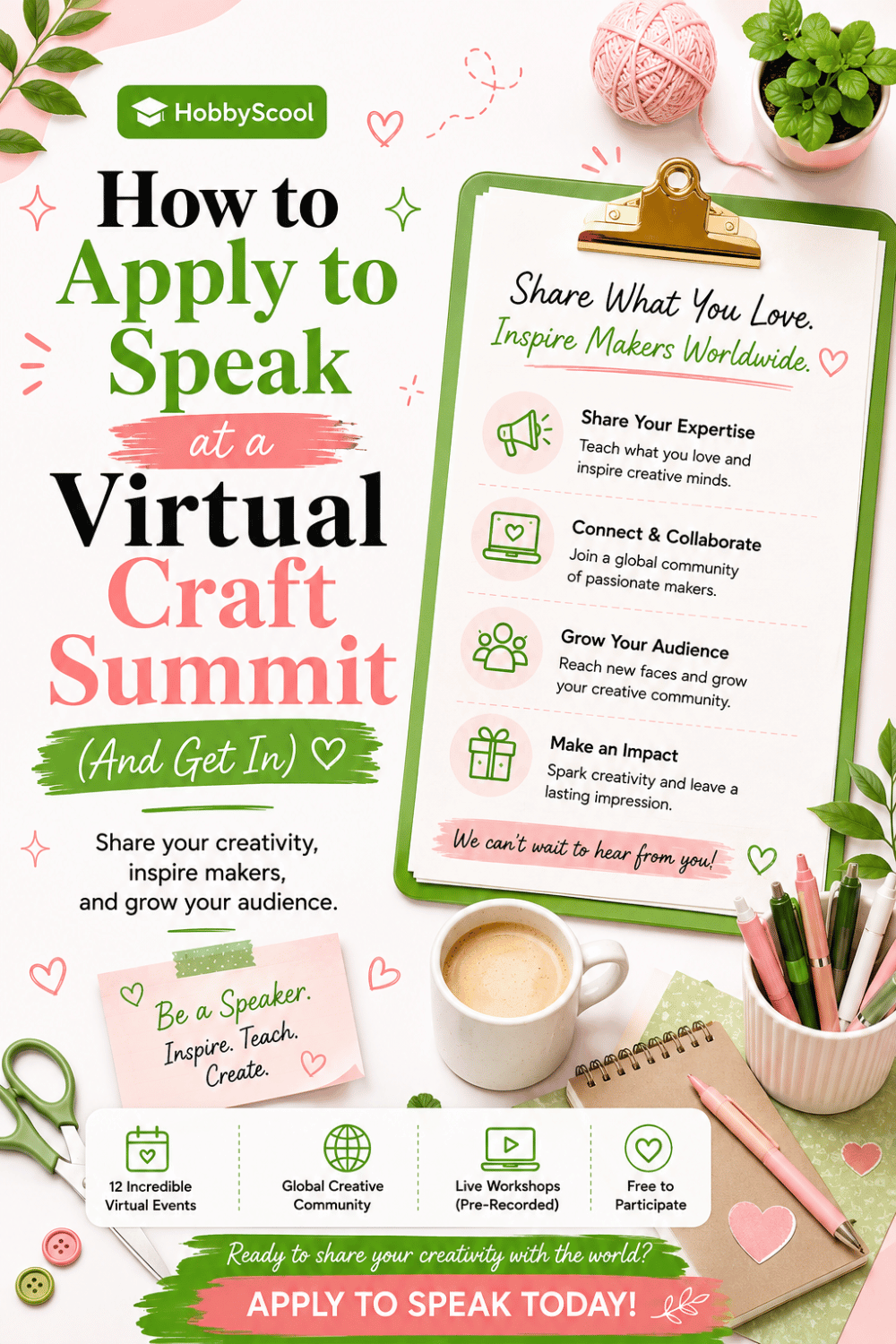
How to Apply to Speak at a Virtual Craft Summit (And Get In)

Most speaker applications don't get passed over because the person isn't good enough. They get passed over because the application didn't say enough to place them.
We read a lot of these. The applications that get an immediate yes and the ones that sit in the database for another few months tend to differ in the same handful of ways, and most of them are fixable in about ten minutes.
So this post is the thing our speaker page can't do. That page tells you what we're looking for. This one tells you how to actually apply, what gets you passed over, and what to do with the spot once you have it so it's worth the recording time.
HobbyScool runs twelve free online summits a year for a list of 40,000 makers, and we book speakers for all of them year-round. Right now we're filling the last three events of 2026 and all twelve of 2027, which is fifteen open events.
What we're reading for
Before the how, here's the what. Every application gets checked against five things:
- You have at least 3,000 email subscribers
- You can produce a clean workshop — clear audio, good light, one project taught start to finish
- Your topic maps to one of the summit themes on the calendar
- You'll promote the free summit to your list during the promo window
- You have a free gift and a landing page ready to collect opt-ins
That fourth one is the one people skim past, so I'll be direct about it. The 50% commission exists because we expect you to promote. That's the trade. We handle the platform, the tech, the attendee support and the sales, and you bring your audience to a free event they'll genuinely enjoy. If emailing your list about it isn't something you want to do, this won't be a good use of your time or ours.
How to apply well
Seven things that move an application from "maybe someday" to "let's get her on the calendar."
Name the event you want
"Any of them, I'm flexible" reads as no preference, and it means we have to do the placing work for you. Open the event cards on the speaker page, find the day theme your craft belongs to, and name it. If you fit two, say both and rank them.
Pitch the workshop, not your résumé
We're not deciding whether you're accomplished. We're deciding whether a specific slot on a specific day gets filled with something an attendee will finish. Tell us the project, the skill level, and what she's holding at the end.
Make the title concrete
"Your First Quilt Block" places itself instantly. "Sewing Basics" doesn't. Same for "Culling 40,000 Photos Down to the Ones That Matter" versus "Photo Organizing Tips." The narrower title is almost always the stronger pitch, because it tells us exactly where it goes and it tells the attendee exactly what she's getting.
Put your topic on the right event
This is the most common near-miss we see, and it's easy to fix. Cardmaking belongs to the June paper crafts summit now, not the November holiday one. Goal setting and year planning belong to January, not the December retreat. Anything that isn't actually making something belongs in October rather than the July tech event. A good pitch on the wrong event still costs you a round.
Bring the free gift with you
Your gift and your landing page aren't a detail we sort out later — they're half of why speaking here is worth anything to you. Tell us what the gift is when you apply. A template, a pattern, a guide, a mini-class, whatever earns an email address from someone who just watched you teach.
Pitch it even if it isn't on the list
The workshops listed under each day are examples of the kind of thing we're after, not a menu to pick from. The strongest applications regularly teach something we hadn't thought of. If your craft fits the day theme, pitch your version of it.
Apply early, and apply once
We review on a rolling basis and we book several months ahead, so applying early puts you in the running for more events. And if you don't hear back right away, it usually just means your topic didn't match the summit we were building that month. Your application stays in the speaker database and we search it every time we plan a new event.
What gets an application passed over
The mirror image, and it's short.
A pitch with teaching bolted on
If the session is really about your program and there's a project attached to justify it, attendees feel that immediately and it hurts your reputation more than it helps.
A vague topic
"Simplify your life," "find your creativity," "craft with intention." Name the room, name the pile, name the project. Vague content underperforms badly with this audience.
No room for the deadlines
Recording and promo dates are firm because thirty other workshops depend on them. If your season is already full, apply for a later event instead.
Now the part most speakers get wrong: making it pay
Getting accepted is the easy half. What you do around the workshop is what decides whether this was a nice thing you did or a real piece of your year.
The list is the asset, so treat the gift like a product
Your workshop streams free for 24 hours to a room of several thousand makers. Everyone who watches sees your free gift and clicks through to your page to claim it. Those subscribers opt in on your form and land on your list directly — we don't hold leads or make you request an export.
Which means the gift is doing the heaviest lifting of anything you bring. Make it the obvious next step after the thing you just taught. If you taught a first quilt block, give her the pattern for the next three. If you taught photo culling, give her the folder structure. A generic "free guide" pulls a fraction of what a matched gift pulls.
"My email list has grown by about 500 new readers. I couldn't be happier. And this group seems to be full of my ideal readers!"
Carol Ann Webster · first-time HobbyScool speaker, Eco-Creative SummitUnderstand what you're actually earning on
Every attendee you send is cookied to you, and you earn on everything they take — not only the first thing. Speakers get 50% on the All-Access Pass, the order bump and the upsell, and 30% on the Craft & Create Club membership.
Here's what that means for one person. She takes the $37 pass, adds the $9 order bump, and grabs the $27 upsell. That single buyer pays you $36.50. If she also joins the Craft & Create Club for the year, you're at $57.50 from one human being. Multiply that by the slice of your list that actually shows up. Across our events we've processed 7,801 transactions and paid out $126,077.28 to 313 partners.
How you promote during the window matters as much as how big your list is. We hand you the email copy, the graphics and your affiliate link, and the easiest thing you can do with all of it is send more than once and rewrite at least one of those emails in your own voice so it sounds like you and not like a swipe file.
Use the premium bonus as a door, not a giveaway
Many speakers donate a paid digital product to the All-Access Pass. It puts your best work in front of every single buyer at the event, and you can include a pass-holders-only discount on your membership, your shop or your app. That's a warm audience who has already paid for something and already watched you teach, which is about as qualified as it gets.
Have the next step built before you record
This is the one I'd underline. A batch of new subscribers lands on your list inside of a few days, and then what happens to them? If the answer is that they get your regular newsletter whenever it next goes out, you've left most of the value of the event sitting there.
Write the welcome sequence before the event. Deliver the gift, teach them something else useful, and then make an offer that follows naturally from what you taught in the workshop. If you plan the follow-up with the same care you'd give a launch, you'll get considerably more out of the three days than visibility.
Remember the shelf life
The three days aren't the end of it. All-Access Pass buyers keep your workshop permanently, and new buyers keep coming after the summit closes. Your gift link keeps working, which is why speakers keep seeing opt-ins trickle in months later. Don't take that landing page down.
"I can honestly say that it helped to grow my email list exponentially. On top of that, I made some extra money as an affiliate."
Robyn Reynolds · OrganizedHarmonieWhat you actually have to do
Four things. We handle everything else — the platform, the promotion, the attendee support, the checkout, the payouts.
- Record one workshop. Pre-recorded, so no live nerves and no timezone math.
- Bring a free gift and a landing page. You host it, you keep the list.
- Promote to your list during the promo window. We give you the copy, the graphics and your link.
- Optionally donate a premium bonus to the All-Access Pass.
It's free to apply, there's no fee to speak, and applications are reviewed year-round. If your craft fits any of the fifteen events currently open, the application takes about five minutes.
Fifteen events are open right now
Three left in 2026 and all twelve 2027 summits. Tell us your topic and we'll match you to the theme that fits.
Apply to speak → See an event firstFrequently asked questions
How many email subscribers do I need to speak at a HobbyScool summit?
At least 3,000. The 50% commission exists because speakers promote the free summit to their own list during the promo window, so list size is part of the fit. If you're under 3,000, build the list first and apply later — applications are accepted year-round.
What should I actually pitch in a craft summit speaker application?
One project or one skill, taught start to finish, named specifically. A workshop called "Your First Quilt Block" reads far better than one called "Sewing Basics." Name the event you want and say what the attendee walks away having made.
Can I pitch a craft topic that isn't listed on the HobbyScool speaker page?
Yes. The workshops shown on each event card are examples of what fits the day theme, not a fixed menu. The strongest applications usually teach something we hadn't thought of. Just make sure it lands on the right event — cardmaking belongs to the June paper crafts summit, not the November holiday one.
Do I keep the email subscribers I get from speaking at a virtual summit?
At HobbyScool, yes, and they come to you directly. Attendees click through to your own landing page to claim your free gift, so they opt in on your form and land on your list. There's no shared attendee list and no export request.
How much can a speaker earn from a HobbyScool summit?
There's no cap. Speakers earn 50% on the All-Access Pass, the order bump and the upsell, and 30% on the Craft & Create Club. One buyer who takes the pass, the bump and the bundle is worth $36.50. Across all events we've paid $126,077.28 in commissions to 313 partners.

Dr. Destini Copp
Founder, HobbyScool · Digital Product Strategist · MBA Professor
Dr. Destini Copp is the founder of HobbyScool, a creative education platform connecting makers, crafters, and hobby enthusiasts with expert educators from around the world. She also runs Creator's MBA, helping digital product creators build sustainable businesses. She's been teaching online business strategy for over a decade.