

Why Handmade Is Having a Moment
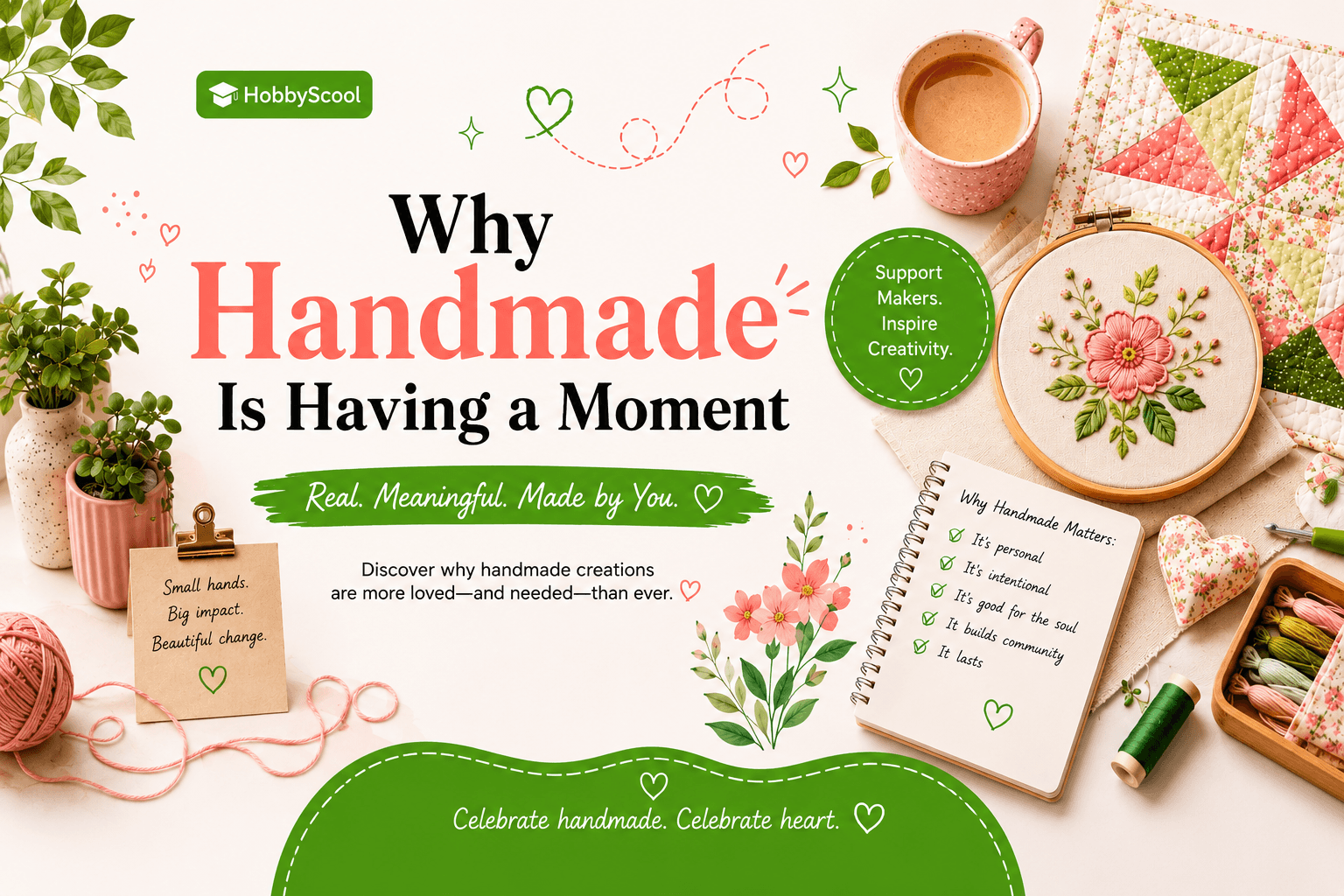
Open Pinterest or TikTok right now and you'll notice something. Between the outfit hauls and the productivity hacks, there's a quieter current running through the feed — hands shaping clay, needles pulling thread, paintbrushes loading up with watercolor, jars of hand-dyed yarn lined up in a sunny window. Slow, tactile, unhurried. And it's not a small corner of the internet anymore. It's everywhere.
If you've felt the pull toward something handmade lately — a sudden urge to learn embroidery, a Pinterest board quietly filling up with pottery and pressed flowers, a craving to make something instead of just consuming one more thing — you're not imagining it, and you're definitely not alone. Handmade is having a moment. Here's why it's happening now, and why HobbyScool built an entire free summit around it.
The Backlash Against Fast Everything
For years, "more, faster, cheaper" was the default setting for how we shopped, decorated, and even created. Fast fashion. Fast furniture. Fast content, made to be consumed in three seconds and forgotten in four. It was efficient. It was also, for a lot of people, quietly exhausting.
That exhaustion has a name now: de-influencing. What started as a wave of creators telling their audiences not to buy the trending product has grown into something bigger — a broader cultural skepticism toward overconsumption itself. People are asking harder questions about what they actually want in their homes and closets, rather than what an algorithm decided everyone should have this month. And increasingly, the answer isn't "the next mass-produced thing." It's something made slowly, made well, and made by an actual person — sometimes that person being you.
Slow Living Isn't Just a Pinterest Aesthetic
"Slow living" and "cottagecore" get filed under aesthetics — all gingham and garden beds and hand-thrown mugs — but underneath the visuals is a genuine values shift. Slow living, at its core, is about choosing depth over speed: cooking instead of ordering, mending instead of replacing, making instead of buying. Pinterest, which publishes its own annual trend forecasting research, has tracked "slow living" and craft-adjacent searches as a recurring theme in its trend reporting for several years running (see Pinterest Predicts). TikTok's own creative community has followed a similar arc, with fiber art, pottery, and "make it don't buy it" content becoming reliable, recurring categories rather than a passing fad.
None of this is about performing a cottagecore fantasy. It's about a real hunger for a slower pace — and handmade crafts happen to be one of the most accessible ways to actually live that value instead of just pinning it.
A Tangible Antidote to All-Digital Lives
Here's the part that feels new about this moment, specifically: a growing share of the content we consume every day isn't just fast — it's not even made by a person. As AI-generated images, captions, and videos become more common across the internet, something in us seems to be pushing back the other direction, reaching for things we know were shaped by a human hand. A hand-stitched pocket square. A wonky first pottery bowl. A card someone folded and glued themselves instead of one printed by the thousand.
That's not a rejection of technology so much as a craving for balance. Most of us aren't logging off entirely — we're just looking for a counterweight. Something we can touch, something that took time, something that couldn't have been generated in half a second. A handmade hobby is one of the simplest, lowest-stakes ways to build that counterweight into an ordinary week.
At HobbyScool, we've been tracking this shift across our own community for a while now — more people showing up not because they want to build a business or master a craft, but because they simply want an hour where their hands are busy and their screen is face-down. That's exactly the feeling The Art of Handmade Summit was built to give people.
What's Actually Driving the Handmade Moment
De-Influencing
A cultural pushback against overconsumption, born on TikTok, that's made "buy less, make more" feel less like restriction and more like relief.
Slow Living & Cottagecore
What began as an aesthetic on Pinterest and TikTok has become a genuine values shift toward depth, patience, and doing things the slower way on purpose.
The "Repair, Don't Replace" Instinct
Mending, upcycling, and visible repair have gone from thrifty habit to genuine craft — a small act of resistance against disposable everything.
Craving Human-Made in an AI-Flooded Feed
As more of what we see online is generated rather than made, handmade objects — imperfect, personal, unmistakably human — feel more valuable, not less.
Why It's Landing So Hard Right Now
None of these forces are new on their own — people have loved handmade goods for as long as there have been hands. What's different in 2026 is that they're all converging at once, and they're reinforcing each other. Overconsumption fatigue makes handmade feel more meaningful. Screen fatigue makes tactile hobbies feel more appealing. A flood of AI content makes anything human-made feel more precious. Put those together and you get a genuine, visible cultural moment — not just a trend cycle that will flip again in six months, but a real recalibration of what people want more of in their lives.
If you've ever wanted permission to slow down and make something with your own two hands — not to sell it, not to post it, just to make it — this is your sign that you're right on time.
And That's Exactly What The Art of Handmade Summit Is For
This is the exact spirit HobbyScool built The Art of Handmade Summit 2026 around. It's a free, three-day online event running September 15–17, where 33 expert makers each teach a workshop — 11 new sessions released every morning, free to watch for 24 hours. There's no app to download, no special equipment required, and no credit card at any point. You register once, and each day's lineup simply arrives as a link in your email.
The theme running through all three days sums up everything in this post in a single sentence: slow down, work with your hands, and remember how good it feels to make something that's truly, unmistakably yours.
The Three Days at a Glance
Botanical printing, mini albums, art journaling, interactive cards, and hand-drawn florals. 11 free workshops, live for 24 hours.
Sewing, embroidery, knitting, crochet, and macrame. 11 free workshops, live for 24 hours.
Polymer clay, mixed media, quilting, fabric painting, and home decor. 11 free workshops, live for 24 hours.
You don't need any experience to jump in, and you don't need to commit to all three days. Drop in for the one topic that catches your eye, or sample all three and see which craft pulls at you most. That's the whole point of a summit like this — a low-pressure way to test the handmade waters before you decide where to go deeper.
Over the next few weeks, we'll be spotlighting the paper, fiber, and clay lineups here on the blog in more detail — introducing the makers, previewing specific workshops, and giving you a closer look at what each day has in store. For now, consider this your invitation to save the dates and come make something with us.
And if you're a maker or educator who'd love to teach a workshop like these yourself someday, HobbyScool is always happy to hear from you — you can learn more and apply at hobbyscool.com/speaker.
Save Your Free Seat
The Art of Handmade Summit runs September 15–17, 2026 — 33 free workshops, no credit card required.
Frequently Asked Questions
It means that after years of fast fashion, mass-produced home goods, and an endless feed of algorithm-driven content, a lot of people are actively choosing slower, tactile, handmade alternatives — not as a niche hobby, but as a visible cultural shift. You can see it in the popularity of "slow living" and cottagecore content on platforms like Pinterest and TikTok, in the de-influencing movement pushing back on overconsumption, and in the simple fact that more people are picking up needles, paintbrushes, and clay instead of scrolling one more app. HobbyScool's creative community has watched this shift happen in real time.
A few forces are converging: fatigue with fast fashion and disposable decor, a cultural pushback against overconsumption known as "de-influencing," and a craving for things that feel tangible and personal in a world that's increasingly digital and, more recently, AI-generated. Making something with your own hands — even something small and imperfect — offers a kind of authenticity and slowness that buying one more mass-produced item simply can't.
The Art of Handmade Summit 2026 is a free, three-day online event from HobbyScool running September 15–17, built directly around this cultural moment. Its theme — slow down, work with your hands, and remember how good it feels to make something that's truly, unmistakably yours — is the handmade trend in action. Each day, 11 new workshops from expert makers go live and stay free to watch for 24 hours, covering paper crafts, fiber arts, and clay, decor, and beyond.
No experience is required. The summit is designed for makers at every level, including complete beginners. Sessions like Victoria Martinez Azaro's botanical printing workshop on Day 1 walk through techniques start to finish, and the whole event is built so you can watch, pause, and try things at your own pace with no pressure to keep up.
Day 1 (Tuesday, September 15) focuses on Paper & Mixed Media — botanical printing, mini albums, art journaling, and interactive cards. Day 2 (Wednesday, September 16) covers Fiber & Fabric Arts — sewing, embroidery, knitting, crochet, and macrame. Day 3 (Thursday, September 17) covers Clay, Decor & Beyond — polymer clay, mixed media, quilting, fabric painting, and home decor. Each day releases 11 free workshops, live for 24 hours, all part of the free registration at HobbyScool.